
Lesson 1 - The Gluten-free Diet: What can Patients with Celiac Disease Eat?
1.5 Clinical response to the gluten-free diet
The gluten-free diet leads to symptomatic, serological and histological remission in the majority of patients (Niewinski et al. 2008). However, this may take some time. Symptoms usually improve and resolve quickly, especially in children. Although symptoms may completely resolve also in adults, gastrointestinal complaints might persist (Midhagen & Hallert 2003). The most common cause of persisting symptoms is ongoing gluten ingestion (inadvertent or voluntary). However, in some patients, mild abdominal discomfort may remain even on a strict gluten-free diet, although the CeD-specific antibodies have normalized. In a very small proportion of patients, refractory CeD causes persisting signs and symptoms (Unit 1 lesson 2) (Ludvigsson et al. 2015).
For most patients, the following clinical effects and improvements will occur:
- Normalization of antibody levels and regeneration of the intestinal mucosa (Newnham et al. 2016) (figure 8)
- Decreased risk of long-term health complications (osteoporosis/osteopenia, lymphoproliferative disorders, autoimmune conditions) (Lebwohl et al. 2013, Ludvigsson et al. 2014)
- Weight normalization if underweight (Samasca et al. 2014)
- In children: catch-up growth and normal physical development (Penagini et al. 2013, de Wit et al. 2013)
- In women: improved pregnancy outcomes and fertility (Ludvigsson et al. 2005, Tersigni et al. 2014)
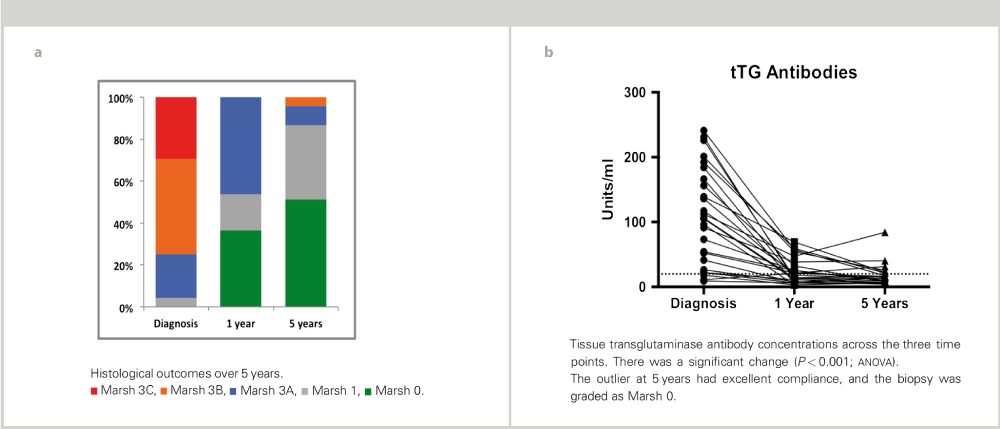
Figure 8: Histological (a) and serological (b) outcomes at diagnosis and 1 and 5 years thereafter in adults with high dietary adherence.
Source: Newnham et al. 2016 Fig. 2 & Figure 3, page 344