Lesson 1 - The Gluten-free Diet: What can Patients with Celiac Disease Eat?
1.4 Special case: oats
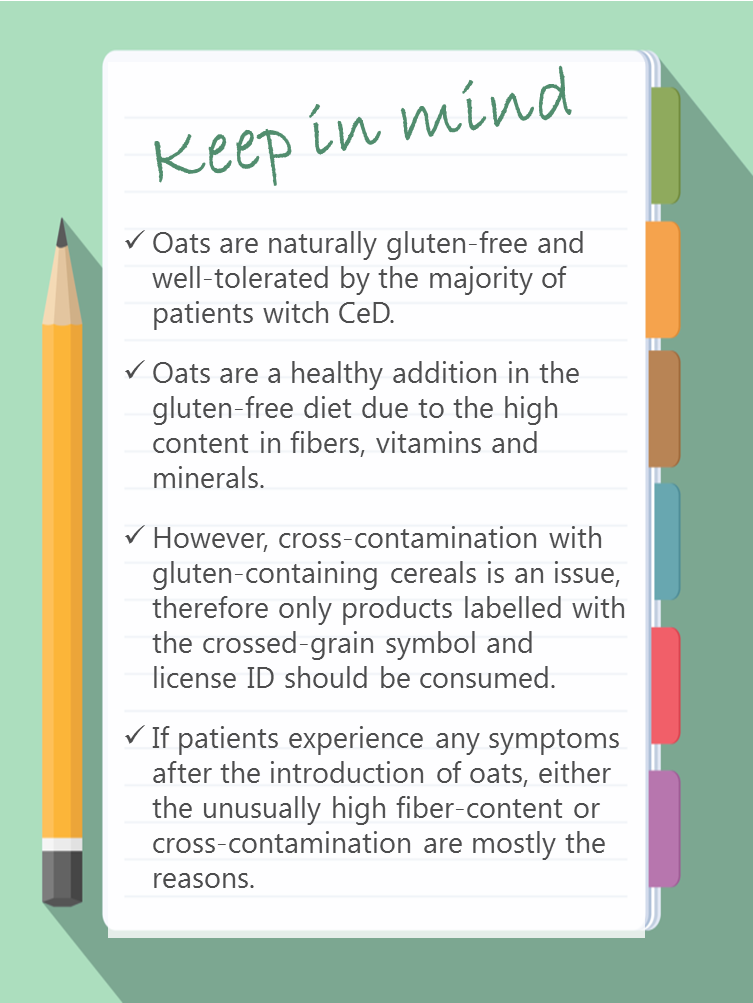
Oats differ from the other major cereals, wheat, barley and rye, by the composition of their storage protein called avenin, making them a naturally gluten-free cereal (figure 7).

Figure 7: Classification of the grass family of grains into sub-families, tribes and species.
The species displayed in red contain gluten which is harmful for patients with CeD and must not be consumed; those in green are gluten-free. Oats are closer related to wheat, rye and barley than e.g. corn or rice, but already differ enough in the epitopes of their storage protein avenin to be considered as gluten-free. Source: FocusINCD own with information from Tanner et al. 2014
However, single cases of CeD symptoms have been reported following oat ingestion (Lundin et al. 2003). Allergy to oat, independent of celiac autoimmunity, can not be excluded in some patients.
These few cases have provoked extensive debate on the correct handling of oats in the treatment of CeD, although they are an excellent source of fiber, vitamins and minerals and are therefore a very healthy addition to the gluten-free diet. CeD societies and other authoritative bodies have not yet reached a uniform consensus, but most of them are leaning towards the inclusion of oats.
The main reasons are (Gilissen et al. 2016):
- Oats have much lower levels of storage proteins compared to wheat (5-15% vs. 50%)
- The epitopes of wheat, barley and rye that trigger the immune system could not be identified in the storage proteins of oats
- Oat intolerance, caused by an immune reaction to oat-specific epitopes, can occur, but is very rare
- There is no scientific proof of cross-reactivity
- The appearance of CeD symptoms after the consumption of oats is mostly due to contamination of oats with barley or wheat
Another reason for abdominal discomfort after the introduction of oats can be the high fiber content of oats, but these issues disappear after a while and are not related to any inflammatory reaction.