
Lesson 1 - The Gluten-free Diet: What can Patients with Celiac Disease Eat?
1.3 What can patients eat?
A strict and lifelong gluten-free diet is the only effective treatment for CeD. So far, there is no other scientifically proven or effective treatment, although several ongoing clinicial trials are investigating the use of drugs (see optional further reading). Although it involves major changes in diet and lifestyle, patients should know that unlike other chronic diseases, this treatment does not require medication with possible adverse effects or other drastic interventions (Niewinski 2008).
When is a gluten-free diet initiated?
It is of utmost importance that the diet is not initiated before all necessary tests for the diagnosis are performed! Otherwise this leads to unnecessary uncertainties and delays in the diagnostic process as test results may be equivocal or false-negative. Consequently, neither the treating physician nor the patient her/himself should decide to reduce or eliminate gluten from the diet prematurely!
The gluten-free diet should only begin when all diagnostic test results are available and the diagnosis is confirmed without any doubt. If possible, the patient should be referred to a dietitian with practical experience how to perform the gluten-free diet and knowledge about the current national food regulations.
View this slide show by clicking on the arrows or on the slide show bar (blue) below and learn more about the sources of gluten in the diet and in non-foods which your patients have to be aware of!
Figure 6: Sources of gluten in the diet and in non-foods
Source: FocusINCD own
Many foods are naturally gluten-free, e.g. fruits, vegetables, animal products, as long as they are not contaminated with gluten during the preparation of meals or convenience foods (see more information below). The huge variety of naturally gluten-free food still allows CeD patients to follow a healthy diet according to the general recommendations.
There are actually only a few grains that are the source of gluten. The most common and most known ones that must be avoided are:
- Wheat, including all wheat varieties like
- Spelt
- Einkorn
- Khorasan wheat (also marketed as Kamut© )
- Farro (also called emmer)
- Durum
- Products usually made from wheat such as bulgur, couscous and semolina
- Rye
- Barley (including pearl barley; barley is also contained in malted drinks, beers, ales, lagers and stouts)
- Triticale (a hybrid of wheat and rye)
Grains that naturally contain gluten and all products made from them such as baked goods (bread, cakes, pizza etc.), pasta, fried foods and beer must be avoided.
Cereal-based products that are exceptions
- Wheat starch: During the production of wheat starch, starch is cleared from gluten, making it virtually gluten-free, except for very low trace amounts that might remain. According to EU law, products containing wheat starch can only be labeled gluten-free if they contain less than 20 mg/kg gluten (Commission Regulation No 1169/2011). Please note that the use of wheat starch as a gluten-free ingredient is not accepted in all countries.
- Wheat based glucose syrups (including dextrose) based on barley or wheat
- Wheat based maltodextrin
- Cereals used in distilled products, e.g. spirits and vinegars
Many manufactured food products may contain gluten in the form of a food additive that is supposed to enhance texture, flavor or other properties of food. Therefore, you find gluten also in many foods where you would not expect it, like sausages, cheese products (natural cheese is always gluten-free), sweets, soy sauce, herbal mixtures and commonly also in (dairy) light products. Since 2014, food manufacturers in the EU must declare on the label if a gluten-containing grain is contained as one of these additives (see "Allergen declaration", Unit 2, lesson 1.2)
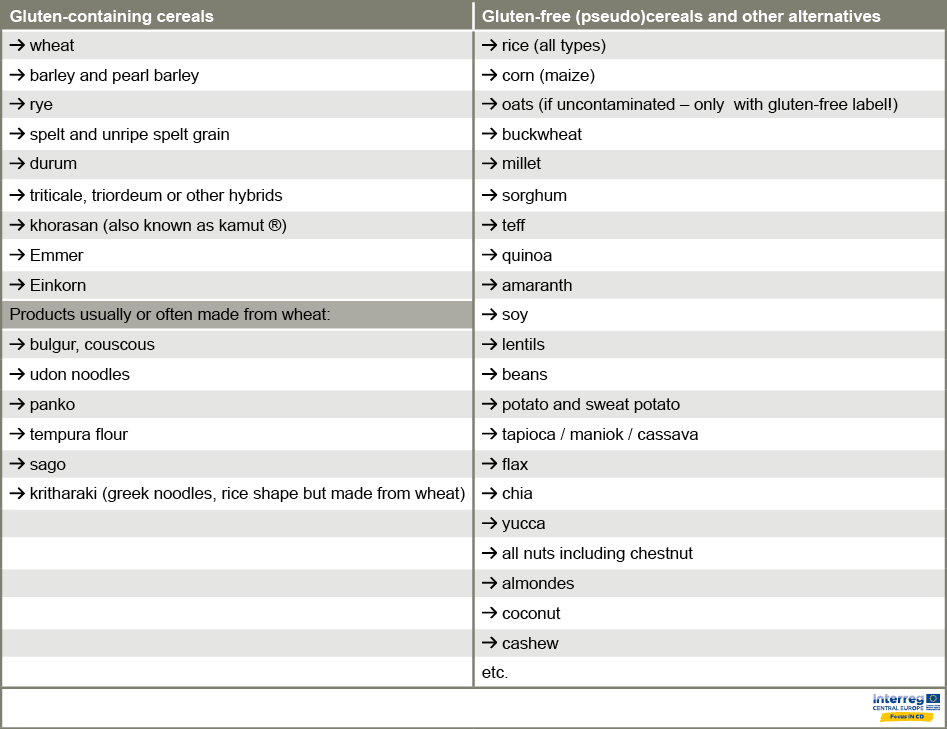
Table 1 Overview of gluten-containing grains and naturally gluten-free alternatives.
Source: FocusINCD own with information from García-Manzanares & Lucendo 2011, Saturni et al. 2010, Coeliac UK 2017a
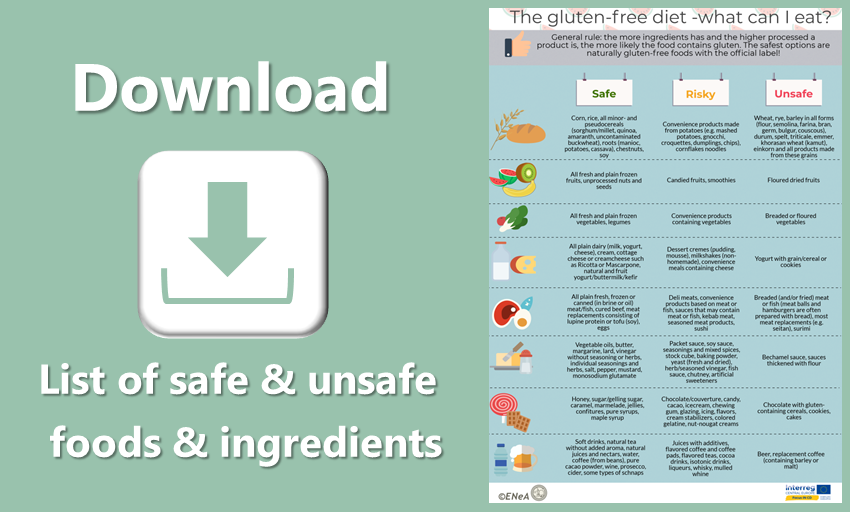
Download here a more detailed overview of safe and unsafe foods which you may hand out to your patients.
Please keep in mind that this cannot replace personal dietary counselling!
Cross contamination, food hygiene and eating out
In CeD, even traces of gluten, which can result from cross-contamination, have to be avoided. Cross-contamination can occur at any time during food handling but is mainly a problem during food preparation. It describes the transfer of proteins such as gluten that cannot be washed off or be destroyed by heating.
The sources of cross-contamination are numerous, often unknown and complex to avoid if the person is not used to it. One example is the use of the same cutting knives and boards for gluten-free and gluten-containing ingredients. Most people are of course not aware that cross-contamination is an issue and how it can be prevented if they prepare food for patients with CeD (Schaefer 2011). Yet, unintentional cross-contamination can be a real problem for the patients and might even cause symptoms or lead to intestinal damage (Abdulkarim et al. 2002, Silvester et al. 2016).
Cross-contamination can be most effectively prevented by proper education of patients, their families, but also of staff in restaurants, hotels, cafeterias, schools, kindergartens & daycares (Menu Nutritional Information 2016).
Non-food
gluten sources
Medication: While gluten exposure from food is obvious, it may also be contained in medication (including dietary supplements) as an inactive ingredient. When ingested, it may be of concern in CeD. It is important to note that the gluten concentration in these products is only low and most medications are gluten-free. Gluten has to be declared when contained in medication and there is usually an alternative medicinal product with the same active ingredient available (Coeliac UK 2018, Erickson 2015).
Cosmetics: Gluten may also be found in cosmetics, e.g. shampoo, toothpaste or lip balm. However, as it is not absorbed via the skin, there is no risk as long as these products are not ingested. Even if small amounts are swallowed, the risk of causing inflammation is negligible. However, some patients prefer to choose gluten-free options for products that might be swallowed, e.g. lip balm or toothpaste (maybe even shampoo in children) to be on the safe side (Coeliac UK 2017b).
Toys: In children, one has to be cautious with some types of toys. Some types of play dough, crayons or modeling clay are made from wheat flour and are therefore not gluten-free. As younger children tend to put toys or unwashed fingers in their mouth, it is important to encourage them not to. In addition, kindergartens, schools and their friends’ parents should know about this issue. There are gluten-free options available (Coeliac UK 2017c).