Lesson 1 - The Gluten-free Diet: What can Patients with Celiac Disease Eat?
1.2 How is gluten-free defined?
Gluten is ubiquitous in the diet and substantial amounts are consumed if a person is not on a gluten-free diet (figure 4, left side).
Although a well-informed and compliant patient will manage to avoid gluten to 99.99%, it's simply impossible to maintain a diet 100% free of gluten. Therefore, the term “gluten-free” refers to an extremely low gluten intake which is below the threshold of being harmful to celiac patients.
Levels up to 10 mg of pure gluten per day were found to be tolerated by the majority of patients (Catassi et al. 2007). Translated into food-terms, this corresponds to a maximum level of 20 mg gluten per kilogramm food (=20mg/kg), sometimes also labelled as 20 parts per million (ppm)) (Ciacci et al. 2015, Joint FAO/WHO Codex Alimentarius Commission 2008).
In other words: if a food contains 20 mg gluten per kilogramm, a person would need to eat 500g of this food to reach the daily threshold of 10 mg.
Figure 4 (right side) shows a practical example of how much gluten may be contained in a slice of bread that is labelled as gluten-free.

Figure 4: Comparison in the amount of gluten between regular gluten-containing bread (left) and gluten-free labelled bread (right).
Regular bread contains high amounts of gluten. A person with celiac disease would have to eat a whole loaf of gluten-free labelled bread to potentially reach the maximum daily threshold of 10 mg gluten. Source: FocusINCD own
Naturally gluten-free (pseudo)cereals and their products might be cross contaminated with gluten containing cereals during harvest or in the mills and may exceed the threshold of 20 mg/kg.
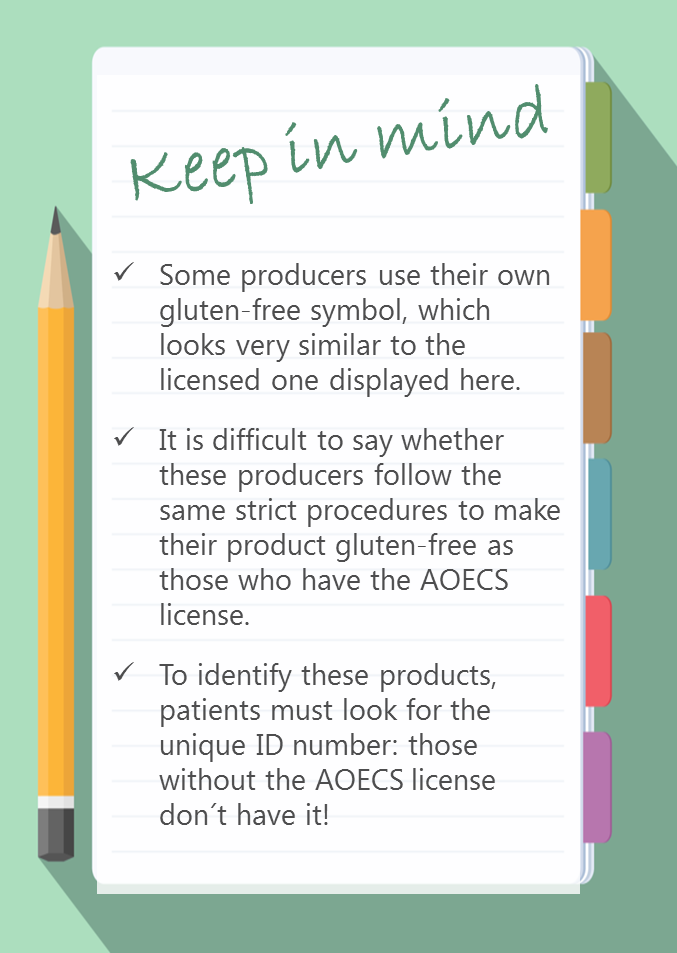
Therefore, only pseudo-cereals or processed foods labelled with the crossed-grain symbol and ID-number should be chosen if available. This label guarantees that a food contains less than 20mg/kg gluten (García-Manzanares & Lucendo 2011). The crossed-grain symbol is a registered trademark that is protected in many countries and is promoted by celiac disease organizations worldwide. To date, thousands of gluten-free products in Europe have been licensed with individual ID-numbers as displayed in Figure 5. All ID numbers are displayed as: "country code - company code - product number". For foods containing oats, the word “OATS” has to be written before the country code. The AOECS (Association of European Coeliac Societies) provides a regularly updated list of the certified products by the member associations from different European countries.

Figure 5: Display of the crossed grain-symbol.
Source: ENeA own, crossed grain symbol with courtesy from German Celiac Disease Society (DZG)
Allergen declaration
In the European Union (EU), all ingredients that commonly cause food allergies and intolerances must be declared on the package (Commission Directive 2003/89/EC). Among these ingredients are gluten containing cereals (wheat, barley, spelt, rye, oat or their hybridized strains) and products thereof.
These allergens have to be denoted and highlighted within the ingredients list, even when gluten is present in the form of additives (Commission Regulation No 1169/2011; Food Standards Agency 2013). Outside the EU, other regulations regarding allergen declaration may apply. National CeD societies can give information that is more detailed.