
Lesson 1: Celiac Disease - Definition, Prevalence and Pathogenesis
1.2 Optional further reading - CeD genetics
Although CeD runs in families, the genes directly responsible for disease development are currently not known. A number of polymorphisms in immune regulatory genes may predispose a person to CeD development or to the development of certain manifestations or severe forms of the disease (Papp M, et al. 2008).
Other types of normal genetic variations, e.g. the presence of type 2 or type 8 forms of HLA-DQ molecules act as permissive genes, because these alleles, which have suitable surface pockets to accommodate negatively charged side chains of deamidated peptides, can present gliadin peptides to the immune system. T-lymphocytes recognize foreign peptides bound to surface HLA molecules of antigen-presenting cells, e.g. dendritic cells, macrophages or B-lymphocytes.
For the CeD-type immune activation, the T-cell receptor and gluten peptide-loaded HLA-DQ should make a proper contact, which cannot be efficiently generated with DQs other than DQ2 or DQ8. Therefore, people without either DQ2 or DQ8 will never develop CeD. Conversely, presence of DQ2 or DQ8 alone is not sufficient for disease development.
DQ2 and DQ8 are normal variations occurring in approximately 30-40% of Caucasians, while they are rare in Black African and Asian populations resulting in a lower risk for CeD in these populations. (Abadie et al. 2011).
Each person has two copies of HLA-DQ genes, one inherited from the father and one from the mother.
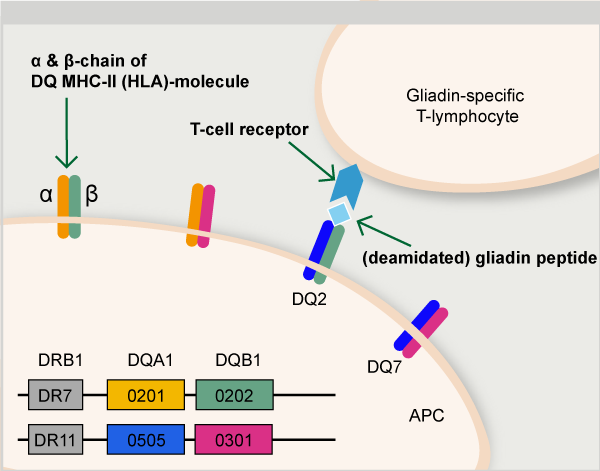
Figure 4:DQ MHC-II surface molecules and their impact in presenting deamidated gliadin to T-lymphocytes
HLA-DQ molecules consist of an alpha and a beta chain and form heterodimers in the cell membrane of antigen presenting cells (APC) to bind peptide antigens and present them to T-lymphocytes. DQA1 genes encode the alpha chain and DQB1 genes encode the beta chain which are usually inherited as haplotype groups with the adjacent DR genes. In a heterozygous person for these alleles, four different heterodimers can be formed, but only those having *0505 alpha chain and *0202 beta chain (DQ2) can present gliadin to the immune system. This situation is called DQ2 in trans, because its alpha chain and beta chain are inherited on different chromosomes. Source: FocusINCD own
The DQ MHC-II surface molecules are heterodimers consisting of an alpha chain encoded by the DQA1 locus and a beta-chain encoded by the DQB1 locus, both highly polymorphic in humans (figure 4). Strings of DRB1-DQA1-DQB1 molecules are usually inherited together as conserved haplotypes with very little recombination rate during many generations. However, some variations cannot be excluded giving rise to unusual haplotype combinations which can indeed present gliadin peptides but will not be recognized as usual DQ2 or DQ8 heterodimers at the testing.
HLA-DQ typing is performed by polymerase chain reaction (PCR) when an amplification product is generated in the presence of allele-specific DNA probes or by evaluating haplotype-associated single nucleotide polymorphism (SNPs). In recent years, technical advances in HLA-DQ typing led to the recognition of more allelic variations which may be misinterpreted as HLA-DQ2 and DQ8 negative results, especially when only one chain (either alpha or beta) gets amplified due to variations on the other chain.
HLA-DQ8 has one major haplotype while DQ2 has two major (DQ2.5 and DQ2.2) and several minor variant haplotypes. The DQ8 [consisting of *03 type alpha chain and *0302 beta chain] and DQ2.5 encoded heterodimers [consisting of *0501 alpha chain and *0201 beta chain] can present gliadin and one copy of them is sufficient to confer risk for CeD. DQ2.2 alone only rarely gives rise to CeD, but when a person has on one chromosome DQ2.2 and DQ7 on the other, the translated proteins forming a heterodimer from the alpha chain of DQ7 [*0505] and the beta chain of DQ2.2 [*0202] make up a heterodimer [*0505/*0202] with almost identical amino acid sequence as in DQ2.5 [*0501/*0201] individuals. This is called DQ2 in trans, with current nomenclature DQ2.2/DQ7, and it is functionally equivalent to DQ2.5.