
Lesson 1: Celiac Disease - Definition, Prevalence and Pathogenesis
1.2 Genetic Risk Factors
CeD is a multifactorial disease with strong genetic susceptibility. The Human Leukocyte Antigen (HLA) variants HLA-DQ2 and HLA-DQ8 are the main predisposing genetic factors (Lundin et al 1994; Spurkland et al. 1997). The HLA gene complex encodes for the major histocompatibility complex (MHC). These cell-surface proteins have an important function in the regulation of the immune system, particularly for antigen presentation and self-recognition. The gluten fragment (deamidated gliadin) has a very high affinity to bind to the HLA-DQ2 or HLA–DQ8 molecules which may induce an aberrant immune reaction (see figure 1) (Koning et al. 2014).
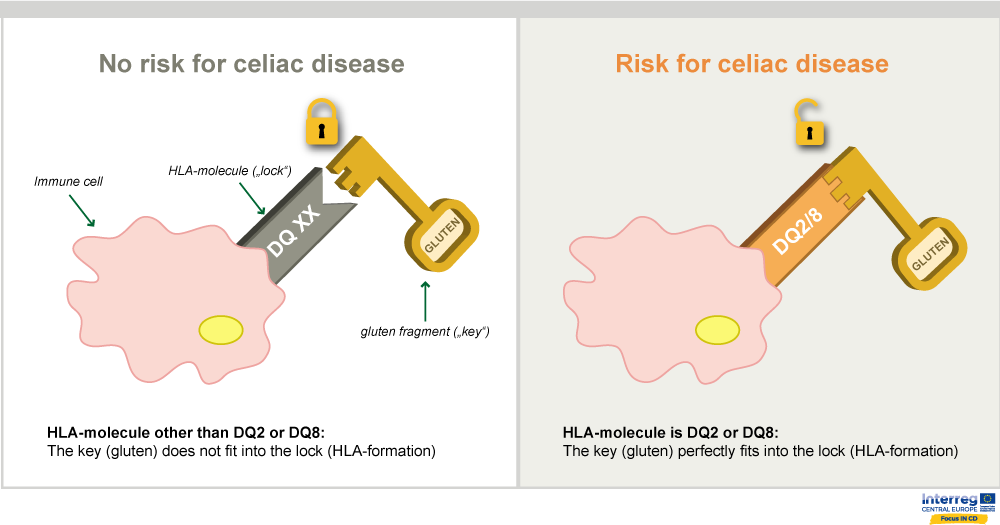
Figure 1 - HLA-DQ2/-DQ8 and its role in the
development of CeD (simplified illustration):
If
HLA-DQ2/DQ8 is not present (left), the modified gluten-fragment (deamidated
gliadin) is not tightly bound by the HLA-molecule on the antigen presenting
cell and does not initiate any immune reaction. If HLA-DQ2 and/or –DQ8 are
present (right), the deamidated
gliadin is bound firmly and an immune reaction may be provoked by a CD4+T-cell
if other yet unknown conditions do also apply.
The presence of HLA-DQ2/DQ8 variants is not specific for CeD as they are found in about 30 to 40% of the general population (see figure 2). However, as nearly all CeD patients are positive for HLA-DQ2 (95%) and/or HLA-DQ8 (5%), the negative predictive value is almost 100% (May-Ling Tjon J et al. 2010, Megiorni & Pizzuti, 2012). Therefore, testing negative for DQ2/DQ8 is of high value to exclude CeD, while a positive result has very little diagnostic value.
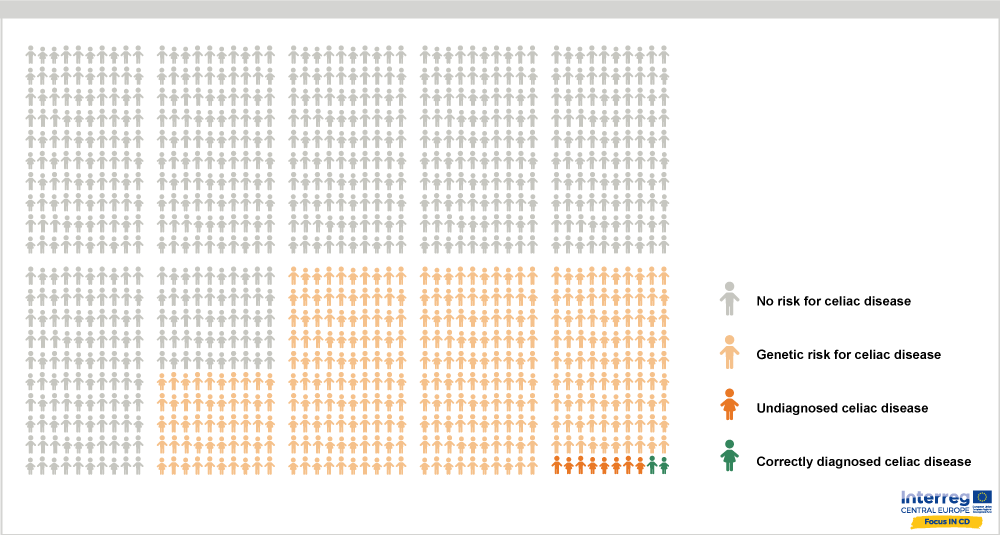
Figure 1: Prevalence of HLA-DQ2/DQ8
and celiac disease.
In a population of 1000 individuals around 350 carry the HLA-risk alleles DQ2 and/or DQ8. In total, about 10 develop CeD. This means 1% of the whole population (respectively 3% of the subgroup with the risk genes) is affected. Two thirds of them are female. Among those with CeD, only 1-2 are medically diagnosed. The remainder may have symptoms that have not been considered as caused by CeD or may experience no obvious symptoms at all. Source: FocusINCD own
There are different variants of HLA-DQ2 in CeD and patients can be either homozygote or heterozygote for DQ2 alleles. These variations along with particular HLA-DQ status define the risk gradient (Megiorni & Pizzuti, 2012.).
The HLA-DQ2 and HLA-DQ8 genes are the most important genes in the development of CeD, but there are also many non-HLA genes associated with an increased risk for CeD. However, these non-HLA genes only explain 14% of genetic variance of the disease, and almost 50% of heritability remains unexplained (Lundin & Sollid 2014).
As HLA and non-HLA genes do not fully explain the development of CeD, environmental processes must also play a role (CR: Unit 1 lesson 2).
Interpretation of HLA-DQ results
A result showing the presence of either DQ2 or DQ8 does not confirm the presence of CeD on its own. Almost 80% of family members of known CeD patients carry DQ2 or DQ8 (Vriezinga et al, 2014). Therefore, DQ typing cannot be regarded as a genetic test to confirm the disease. DQ2 and DQ8 are part of the normal immune system. Furthermore, DQ2 and DQ8 are not inherited together with CeD within a family (figure 3).

Figure 3: CeD is not inherited together with HLA genes.
In this family, two
of the three children of a celiac mother developed the disease (orange). The
first daughter inherited DQ2 from the mother, but the second daughter with CeD
did not. However, she received from the healthy father DQ8 as genetic predisposition
background and permissive gene. The third child has neither DQ2 nor DQ8
and is healthy. Source: with courtesy from Ilma Korponay-Szabó, Budapest
On the other hand, a negative result for both DQ2 and DQ8 testing is diagnostically useful to exclude CD in controversial cases. However, rare variations can occur and in subjects seropositive for auto-antibodies against EMA and/or transglutaminase, a negative DQ2/DQ8 result should be re-evaluated by a detailed testing with a combination of methods.